Every week brings a new “SEO is dead” headline, a new acronym, or a new AI shortcut that promises to put your business at the top of ChatGPT. Most of it is noise. Some of it costs businesses real customers.
Search hasn’t died. It has spread out. Customers now find businesses through Google, AI Overviews, ChatGPT, Gemini, maps and directories, often in the same afternoon. That shift is real. Most of the panic around it isn’t.
Why Are There So Many Myths About Search Right Now?
Search is changing faster than most marketing teams can keep up with. When a channel that drives this much revenue shifts, two camps form fast. One declares SEO dead. The other insists nothing has changed. Both are wrong.
The customer journey is decentralizing. A single buying decision might start with a Google search, move to an AI answer, detour through a map listing, and end on a review site. But the fundamentals still hold: AI tools lean on the same websites, listings, and rankings that SEO builds.
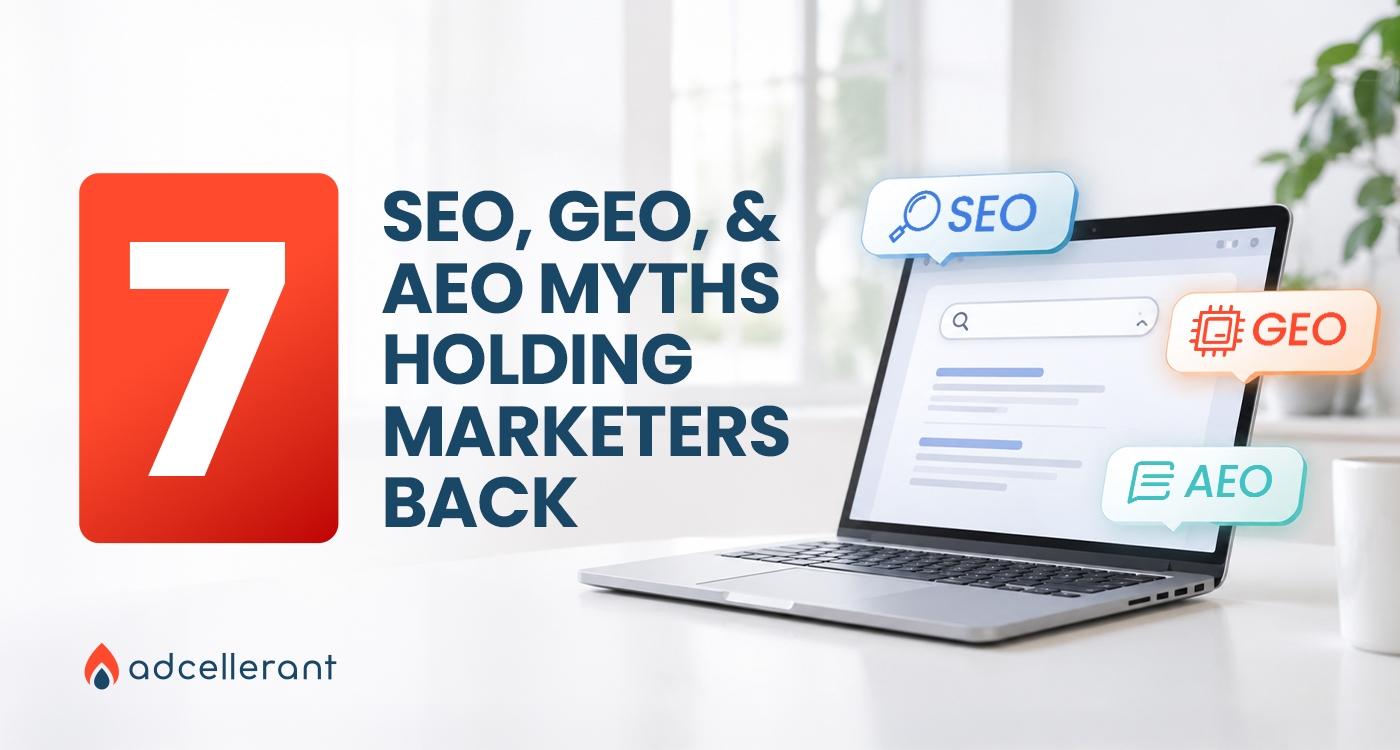
Three terms dominate the conversation. Here’s what each one means:
- SEO (search engine optimization) earns visibility in traditional search results, including Google’s organic listings and local map results.
- GEO (generative engine optimization) makes your business easy for AI tools such as ChatGPT, Gemini, and Google AI Overviews to find, trust, and cite.
- AEO (answer engine optimization) structures your content so it answers customers’ questions directly, in a form search engines and AI tools can lift into an answer.
These aren’t rival strategies. They’re overlapping layers, and SEO is the foundation the others build on. While GEO and AEO each have their own areas of emphasis, they share the same core practices. A technically sound website, genuinely useful content, credible information, and consistent business details are what earn visibility in traditional search, and they’re the same signals AI-powered platforms rely on when deciding what to surface and cite. Get that foundation right, and you’re already doing most of the work that GEO and AEO require. Here’s what most of the hype misses: the biggest threat to your search visibility isn’t AI. It’s the myths about AI. Businesses that invest in what search engines and AI platforms actually trust will capture the demand their competitors leave behind. These seven myths are the ones worth retiring first.
Myth No. 1: Is SEO Dead Because of AI?
The reality: SEO isn’t dead. It’s changing shape, and AI answers still depend on it.
Traditional search remains the main way Americans find information. About 95% of Americans are still regular traditional search users, according to SparkToro and Datos research reported by MarketingProfs. AI tool use is growing alongside search, not replacing it.
Google’s lead remains enormous. Google accounted for 73.7% of U.S. desktop search activity in the fourth quarter of 2025, while all AI tools combined accounted for 3.2%. On phones, Google’s dominance among search engines is even greater. Google held 91.36% of U.S. mobile and tablet search engine share in May 2026, according to StatCounter.
Rankings and AI visibility also go hand in hand. Pages ranking in positions 1-3 were cited by at least one AI platform 98.9% of the time, according to Rankability. Rankability notes that rankings and citations may share common drivers, such as authority and relevance. Either way, the pages that win in search are the pages AI tools trust most.
Even AI companies are betting on SEO. Anthropic, the company behind Claude, hired an SEO lead and describes the discipline as “in a state of change.” That’s not how anyone talks about a dead channel. The businesses declaring SEO dead aren’t saving money. They’re giving up ground.
Myth No. 2: GEO and AEO Replace SEO
The reality: GEO and AEO extend SEO. They don’t replace it. Organic SEO is the foundation of AI visibility, working alongside clear content, accurate listings, structured information, and third-party mentions.
Ranking at the top still makes an AI citation likely. What has changed is how many other pages can earn one, too.
Only 38% of pages cited in Google AI Overviews rank in Google’s top 10 for the same query, down from 76% in mid-2025, according to Ahrefs. Across AI platforms, about a third of citations go to pages that don’t rank in Google at all, often directories, listicles, and review sites, according to a separate Rankability study. That gap doesn’t prove SEO stopped mattering. It proves AI tools search more broadly than people do.
What Business Should Do Instead
Rather than replacing traditional SEO with a separate AI strategy, businesses should strengthen the foundation that supports both:
- Maintain a technically sound, crawlable website. If search engines and AI tools can’t access and understand your pages, nothing else you do will matter.
- Develop unique, helpful content around your services and customer questions. Content that directly answers what your customers are asking is what both search results and AI answers are built from.
- Strengthen your business information across relevant platforms. Consistent, accurate details in directories, listings, and review sites give AI tools more trustworthy sources to pull from, and those are often the pages they cite.
- Monitor organic search performance alongside AI search visibility. Tracking both shows where you’re earning visibility and where competitors are showing up instead.
- Build credibility through genuine expertise and reputable third-party mentions. AI platforms favor sources that others already trust, so earning mentions beyond your own website expands your reach.
How Query Fan-Out Works
Some AI-powered search systems use a process known as query fan-out, where a complex question is broken into multiple related searches to gather supporting information. This means businesses may have opportunities to appear for specific aspects of a customer’s question, even when they don’t rank first for the broadest keyword.
Take a search such as “best family dentist in Denver accepting Delta Dental.” An AI tool that uses query fan-out might run several sub-searches, each one pulling from a different source:
| AI Checks | Where It Looks | What the Business Needs |
| Which Denver dentists take Delta Dental? | Website, insurance pages, listing attributes | A clear insurance page and accurate listing details |
| Who has the best reviews? | Google reviews, review sites | Recent reviews with owner responses |
| Which ones treat kids? | Service pages, directories | Dedicated pages for each service |
| Who is accepting new patients? | Website FAQs, Google Business Profile | Current, consistent information everywhere |
A dentist who ranks for “Denver dentist” but buries insurance details in a PDF could miss most of those sub-searches. A competitor with clean listings and clear service pages is better positioned to pick them up.
Write for People and Machines
Content now has two audiences. The structure that helps a busy reader also helps an AI tool find and quote the right answer:
- Lead with the answer. Put the bottom line up front, then add detail.
- Answer real questions. Build FAQs around what customers actually ask.
- Show who wrote it. Clear authorship and credentials signal expertise.
- Break it into chunks. Short sections with descriptive headings are easier to scan and cite.
Myth No. 3: AI Overviews Make Organic SEO Not Worth It
The reality: AI Overviews do reduce clicks. But paid ads are taking a growing share of clicks, too. Search isn’t just being automated. It’s being re-monetized.
Start with the honest part. Users clicked a result on 8% of visits that included an AI summary, compared with 15% of visits without one. And 68% of U.S. Google searches ended without a click in early 2026, according to Search Engine Land.
The opportunity is in combining both. Paid search helps businesses compete for high-intent, transactional queries, while strong organic content and accurate listings build visibility in traditional results and AI-generated answers. Together, they help businesses reach customers across more of the search journey.
Now the part most coverage misses. Organic click share fell 11 to 23 percentage points year over year, while text ads gained 7 to 13 points, according to an analysis by SEO consultant Aleyda Solis. AI answers aren’t the only thing pushing organic results down the page. Ads are taking more space and more clicks.
Not every search behaves the same way, either. Someone asking how photosynthesis works may never click. Someone searching for an emergency plumber, a specific brand, or a store’s hours usually does. Local, branded, and transactional searches still earn meaningful clicks, and those clicks tend to come from people ready to buy.
Being cited can help, too. Brands cited in AI Overviews saw a 35% higher organic click-through rate than brands that weren’t, according to Seer Interactive research, though the researchers note that stronger brands may simply be more likely to get cited.
The takeaway: Sessions alone no longer tell the whole story. Track qualified leads, calls, form fills, and conversions, plus search impressions and AI referral traffic. Fewer, better-qualified visitors can mean more revenue, not less.
Myth No. 4: You Can’t Control What AI Says About Your Business
The reality: Most AI citations come from sources a business already owns or manages.
Of the 6.8 million AI citations Yext analyzed, 86% came from brand-managed sources. Websites and business listings make up the large majority of what AI tools cite when they talk about local businesses.
Control isn’t all or nothing. It runs along a spectrum:
| Source | How Much You Control | Where to Focus |
| Your website | Full | Accurate, in-depth pages for every service and location |
| Business Listings | High | Consistent name, address, phone, hours, and services everywhere |
| Reviews and Social | Shared | Ask for reviews, respond to every one, post regularly |
| News and forums | Low | Earn coverage and mentions through real expertise |
The top two rows do most of the work. That’s good news: The sources AI trusts most are the ones you can fix this week.
The bottom of the spectrum is where volatility lives. Reddit’s share of ChatGPT Search citations fell from 3.83% to 0.52% in mid-August 2026, according to TechRepublic. Reddit still appears in Google AI Overviews and Gemini, so community participation still has value. But a strategy built on borrowed platforms can change overnight. One built on assets you own holds up.
Myth No. 5: If We Show Up in ChatGPT, We’re Covered
The reality: There is no single “AI search.” Each platform cites different sources, so optimizing for one misses most of the opportunity.
AI platforms rarely agree. No pair of AI platforms shared more than 24.1% of the pages they cited, according to Rankability. A business that shows up in ChatGPT may be invisible in Gemini, Google’s AI Mode, or Perplexity for the same question.
Platforms also favor different kinds of sources. Gemini leaned toward websites, while OpenAI’s tools leaned more on business listings, according to Yext research. That means a strong website alone won’t cover every platform, and neither will strong listings alone.
Your customers don’t pick one tool and stay there. They ask Google, then a voice assistant, then a chatbot on their phone. Your business information needs to reach all of them, including Google, Bing, Apple Maps, Meta AI, Alexa, ChatGPT, and Gemini, and it needs to match everywhere.
Measurement should follow the same logic. Track how your business appears across several AI platforms, not just the one that gets the most headlines.
Myth No. 6: Listings Are a One-Time Setup
The reality: Listings are living data. Actively managed listings outperform neglected ones, especially in crowded markets.
Businesses with managed listings ranked 2.71 positions higher in local results within one mile, and 6.20 positions higher in markets with 100 or more competitors, according to Yext research. The more competitive the market, the bigger the advantage.
One caveat: The study is observational. Managed businesses were also far more likely to have claimed their profiles, at 99.8% compared with 77.9%. Management correlates with higher rankings, but it isn’t the only factor. Even so, the pattern is hard to ignore.
Accuracy matters even more in AI search. When your hours, address, or phone number conflict across platforms, AI tools have less reason to trust any of them. Inconsistent data gives an AI tool a reason to recommend someone else.
Keeping listings healthy is ongoing work:
- Update hours for holidays, seasons, and special events.
- Keep services, products, and insurance or payment details up to date.
- Respond to every review, positive and negative.
- Post regular updates to your Google Business Profile.
- Audit listings across directories for duplicates and outdated details.
Myth No. 7: Mass-Produced AI Content is the Fastest Way to Win AI Search
The reality: Volume without value is a liability. Google allows AI-assisted content, but it penalizes scaled, low-value content, and AI platforms reward depth.
Google doesn’t ban AI content. It targets scaled content abuse. Google Search Central warns that generating many AI-created pages without adding value for users may violate its spam policies. The issue isn’t the tool. It’s the shortcut.
Google is also raising the bar for review. An Oct. 1, 2026, update to its guidance stresses human checks of AI-generated content before it goes live. AI platforms point in the same direction. Pages with thorough topic coverage earned a top-10 AI citation rate of 27.6%, compared with 14.5% for pages with thinner coverage, according to Rankability. Fifty shallow pages don’t beat one page that fully answers the question.
The winning model is human-led and AI-assisted. Use AI to research, outline, and speed up drafts. Use people to add real experience, check facts, and make the judgment calls. That’s what Google’s E-E-A-T framework rewards: experience, expertise, authoritativeness, and trustworthiness.
What Does a Modern SEO, GEO, and AEO Strategy Look Like?
The biggest threat to your search visibility isn’t AI. It’s the myths about AI. The strongest strategies don’t choose between SEO and AI. They build one foundation that serves both, then measure it everywhere customers search.
Each part of that foundation comes with a question worth asking your team:
- A strong, crawlable website earns rankings and the AI citations that follow them. Ask: Is our website technically sound, fast, and mobile-friendly?
- Accurate, synchronized listings keep your business facts consistent on every platform. Ask: Is our business information accurate everywhere customers and AI tools look?
- Active reputation management turns recent, answered reviews into fuel for “best” searches. Ask: Are we earning new reviews and responding to every one?
- Content for people and machines answers questions in depth, leads with the answer, and shows who wrote it. Ask: Can customers find us by service, problem, and city, and does our content answer what they ask AI tools?
- Multi-format visibility extends your reach through YouTube, AI video, press releases, and infographics. Ask: Are we showing up anywhere besides our own website?
- Modern measurement tracks impressions, keywords, conversions, and AI referral engagement. Ask: Are we measuring visibility across Google and several AI platforms, not just sessions?
Most businesses don’t need a separate AI search budget to do this. The same investments that build SEO, including a strong website, accurate listings, reviews, and in-depth content, also earn AI visibility. What changes is where the money goes: more toward listings management, content depth, and tracking across multiple AI platforms.
The best opportunities belong to businesses whose customers actively search, compare, and choose. If that describes your customers, the shift to AI search isn’t a threat. It’s an opening, and it favors the businesses that act on facts instead of headlines.
Is Your Business Visible Where Customers Are Searching?
Traditional search rankings are only part of the picture. Understanding how your business appears across Google and AI-powered search experiences can help uncover opportunities to strengthen your digital visibility.
Connect with our SEO team to explore how your current strategy supports both traditional and AI-driven search.
Frequently Asked Questions About SEO, GEO, and AEO
What’s the difference between SEO, GEO, and AEO? SEO earns visibility in traditional search results. GEO makes your business easy for AI tools such as ChatGPT and Gemini to find, trust, and cite. AEO structures content to answer customers’ questions directly. They work best together, with SEO as the foundation.
How long does it take to see results? SEO builds over time. Some improvements, such as correcting listings or technical errors, can show results within weeks. Most businesses see meaningful gains in rankings and AI visibility within three to six months, so we plan campaigns around that timeline
How can I tell if my business shows up in AI answers? Start by asking AI tools the questions your customers ask, across several platforms, including ChatGPT, Gemini, Perplexity, and Google’s AI Overviews. Then check your analytics for referral traffic from AI tools. For ongoing tracking, use an AI visibility reporting tool or work with a partner that monitors multiple platforms.
Do I need a separate budget for AI search? Usually not. The same work that builds SEO, including a strong website, accurate listings, reviews, and in-depth content, also builds AI visibility. Most businesses benefit more from shifting existing spend toward listings management, content depth, and cross-platform tracking than from adding a new line item.
Does structured data (schema) help with AI visibility? Yes, as part of a broader strategy. Structured data labels key facts, such as your business type, location, hours, services, and FAQs, so search engines and AI tools can read them reliably. It doesn’t guarantee a citation on its own, but it removes guesswork about who you are and what you offer.